Buy now, pay later sounds almost perfect when you’re staring at a $200 shopping cart and checkout suddenly tells you:
“Or pay $50 today.”
Well, $50 sounds considerably nicer than $200.
And that’s exactly why Buy Now, Pay Later – usually called BNPL – has become so popular.
Instead of paying the entire purchase price at once, companies such as Affirm, Klarna, Sezzle, Afterpay, PayPal, and Zip let eligible shoppers break purchases into smaller payments.
Sometimes those payments really are interest-free.
Sometimes they’re not.
And sometimes something advertised as “interest-free” still comes with a service fee, origination fee, late fee, subscription charge or another cost you need to know about.

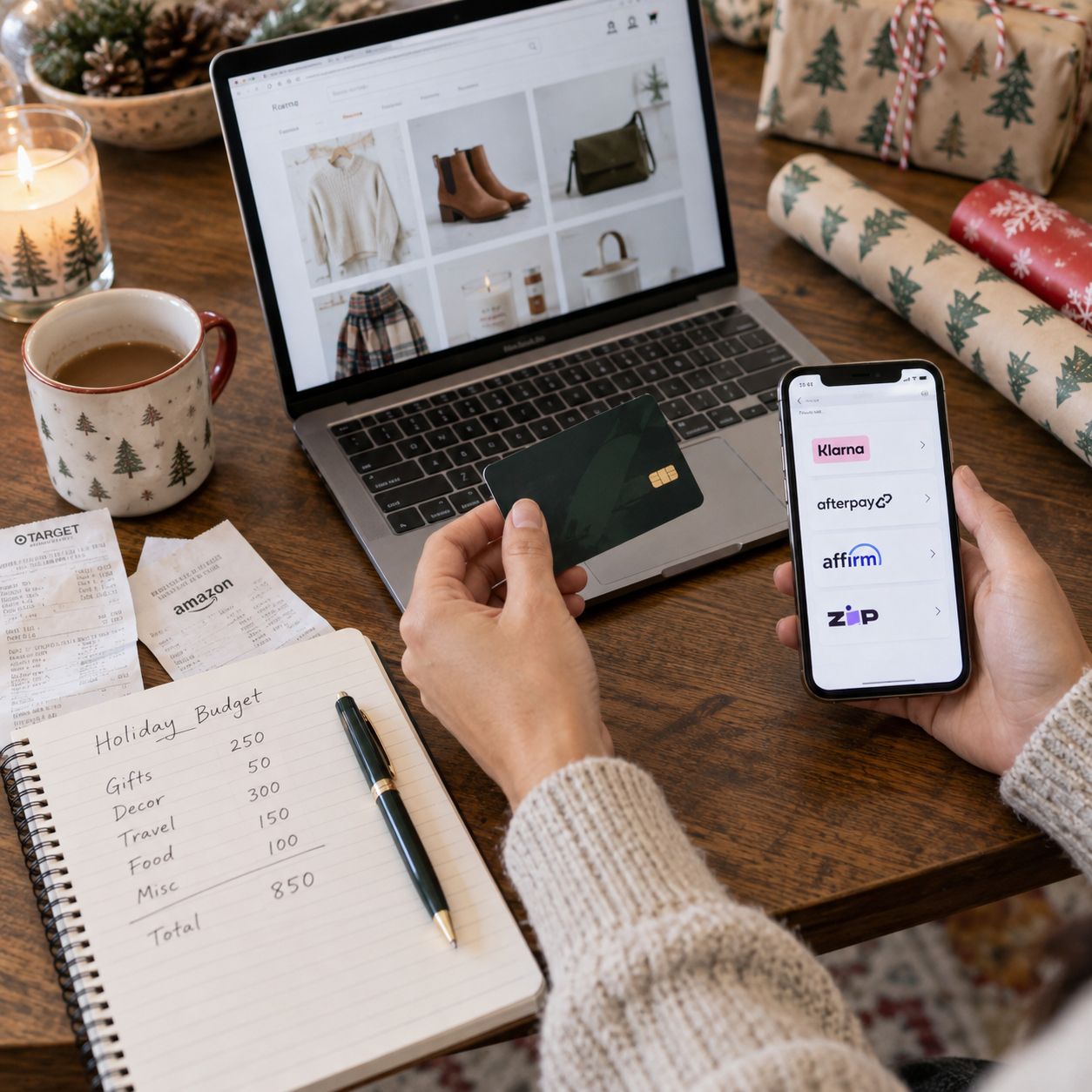
With Christmas and holiday shopping coming up, this is especially important.
Four payments of $25 don’t make a $100 gift cost $25.
You still spent $100.
And if you have six different “little” payments coming out of your account from three different apps over the next several weeks, Christmas can get expensive very quickly while feeling like it’s not.
So let’s look at how Buy Now, Pay Later actually works, compare the major BNPL companies, and figure out which options really cost the least – and when you might want to skip using BNPL altogether.
Disclaimer: BNPL products, rates, fees and eligibility change frequently. The information below is based on U.S. terms available in September 2026. Always check the terms shown to you before accepting a payment plan.
What Is Buy Now, Pay Later?
The traditional BNPL plan is pretty simple.
You purchase something today and divide the cost into four (or a few more) payments.
Usually:
- 25% is due when you purchase
- Another 25% is due two weeks later
- Another 25% two weeks after that
- The final 25% is due two weeks later
That means the purchase is paid off in about six weeks.
But BNPL has expanded far beyond the original Pay-in-4 model.
Several companies now offer:
- Two-payment plans
- Pay-in-4 plans
- Pay-in-8 plans
- Pay in 30 days
- Monthly installment loans
- Virtual cards
- In-store BNPL
- Longer financing for larger purchases
Depending on the provider, longer-term financing can stretch anywhere from a few months to several years.
That’s also where you need to pay much closer attention to interest.
The Major Buy Now, Pay Later Companies
The six major U.S. BNPL providers identified in Consumer Financial Protection Bureau research are:
- Affirm
- Afterpay
- Klarna
- PayPal
- Sezzle
- Zip
There are also other options worth knowing about, including Splitit and Bread Pay.
You’ll also see names such as Shop Pay Installments and installment options inside Apple Pay, but those aren’t necessarily separate BNPL companies. Shop Pay Installments is powered by Affirm, while Apple Pay can surface third-party installment options including Affirm and Klarna.
Quick BNPL Comparison
| Service | Basic Short-Term Plan | Cost When Used as Intended | Late Fees? | Longer Financing? |
|---|---|---|---|---|
| Affirm | Pay in 4 | 0% APR | No Affirm late fees | Yes, 0%–36% APR |
| Klarna | Pay in 4 | No interest/fees when paid on time at eligible merchants | Up to $7 on Pay in 4 | Yes, up to 35.99% APR |
| Afterpay | Pay in 4 | Free at partner merchants when paid on time | Up to $8 per missed installment, limits apply | Yes, up to 35.99% APR |
| PayPal | Pay in 4 | Interest-free, no PayPal late or signup fees | No PayPal late fee | Yes, 9.99%–35.99% APR |
| Sezzle | Pay in 4 | Interest-free, but service fees may apply to some transactions | Several possible fees depending on transaction/state | Yes |
| Zip | Pay in 2, 4 or 8 | Origination fee may apply | Up to $7 | Multiple installment choices |
| Splitit | Varies | No added Splitit interest/fees; credit-card terms still apply | Through your card terms | Uses existing card |
| Bread Pay | Pay in 4/SplitPay | Generally interest-free short-term plan; terms vary | May apply on some plans | Yes |
That’s the short version.
The differences become much more important once you start digging into each company.
Affirm
Affirm is one of the biggest BNPL companies and probably one of the easiest to recognize because you’ll see it directly at checkout with a lot of retailers.
Affirm offers two substantially different kinds of financing.
Affirm Pay in 4
Pay in 4 divides the purchase into four payments every two weeks.
Affirm’s Pay in 4 option is currently 0% APR.
Also Affirm doesn’t charge late fees.
That makes basic Pay in 4 one of the cleaner BNPL products from a fee standpoint.
Affirm Monthly Payments
Larger purchases may qualify for longer installment plans.
Those can range from 0% to 36% APR, depending on the customer, merchant, purchase amount and available offer.
That’s a huge range.
At 0%, terrific.
At 36%, we’re having an entirely different conversation.
Always look at the total amount you’ll repay, not just the monthly payment.
Affirm tells you the full repayment cost before you accept the loan and doesn’t charge compound interest or late fees.
Does Affirm Check Your Credit?
Checking your eligibility or purchasing power generally involves a soft inquiry that doesn’t affect your credit score.
That does not mean every purchase will be approved.
Affirm evaluates transactions individually, and the amount, merchant, existing obligations and other factors can affect the offers you’re shown.
There is another important change people may not know about.
Beginning in April 2025, Affirm expanded its reporting to Experian to include all of its pay-over-time products.
So while checking eligibility may not hurt your credit score, an Affirm loan itself can become part of your credit history.
Where Can You Use Affirm?
You can find Affirm directly at participating retailers, through the Affirm app and through virtual-card options.
Affirm also works through certain digital-wallet experiences and powers Shop Pay Installments.
So if you see Shop Pay Installments, understand that you’re actually applying for financing through Affirm.
Affirm Pros
- Pay in 4 is 0% APR
- No Affirm late fees
- No compound interest
- Long-term financing available
- Widely available
- Clear total repayment amount
- Soft eligibility check
- Can pay loans off early
Affirm Cons
- Longer plans can reach 36% APR
- Approval isn’t guaranteed
- A down payment may be required
- Payment plans may be reported to credit bureaus
- What you’re offered can vary from purchase to purchase
My Take on Affirm
Affirm Pay in 4 is one of the better options in this group if you’re approved for the 0% plan and you can comfortably make all four payments.
For monthly financing, compare the APR with every other option available before saying yes.
A 0% Affirm offer and a 36% Affirm offer may have the same logo, but financially they are most definitely not the same thing.
Klarna
Klarna has grown into way more than a four-payment app.
Depending on the transaction, shoppers may see:
- Pay in 4
- Pay in 30 days
- Pay over time
- Pay in full
Klarna Pay in 4
Klarna’s standard Pay in 4 divides a purchase into four interest-free payments, generally every two weeks.
At participating merchants, there’s no interest and no fee when you pay on time.
However, missed Pay-in-4 payments can add a late fee of up to $7, with total late fees capped based on the order amount.
Klarna Pay in 30
This one’s interesting.
Instead of dividing the purchase into installments immediately, eligible shoppers can have up to 30 days to pay.
There is no interest or late fee when the plan is handled according to its terms.
This can be particularly useful when ordering something you’re unsure you’ll keep because you may be able to return the product before paying for it.
Klarna Monthly Financing
Klarna also offers longer financing.
Current U.S. disclosures show rates ranging from 0% to 35.99% APR, depending on creditworthiness, term and approval.
Again, don’t let a low monthly payment distract you from the APR.
Watch Out for Klarna One-Time Card Fees
Klarna can also create a one-time virtual card so you can use Klarna at places that don’t directly offer it at checkout.
Convenient?
Absolutely.
Necessarily free?
No.
Some one-time-card Pay-in-4 transactions can include a service fee.
That’s why I wouldn’t automatically assume that because your normal Klarna Pay-in-4 purchase is free, every way of using Klarna is free.
Does Klarna Check Credit?
Klarna currently says it performs a soft credit check for Pay in 4, Pay in 30 and Pay-over-time products.
The soft inquiry doesn’t affect your credit score.
Klarna doesn’t publish one universal credit score required for approval.
Approval is made for each purchase and can consider current credit information, outstanding debt and how you’ve handled previous Klarna payments.
Klarna Pros
- Pay in 4 can be completely free
- Pay in 30 gives another useful option
- Long-term financing available
- Soft credit checks
- Broad merchant availability
- One-time card expands where it can be used
- Available through Apple Pay in eligible transactions
Klarna Cons
- Pay-in-4 late fees can apply
- One-time-card fees may apply
- Monthly financing can become expensive
- Approval changes from purchase to purchase
- “Purchase power” isn’t guaranteed approval
My Take on Klarna
I like basic Klarna Pay in 4 at a participating retailer.
It’s simple and can cost nothing when used correctly.
The farther you move from that basic product – virtual cards, special financing, longer repayment – the more carefully I’d pay attention the total cost.

Afterpay
Afterpay built its name around Pay in 4, but it now offers longer financing too.
Afterpay Pay in 4
When you’re shopping with an Afterpay partner merchant, Pay in 4 is free if you pay on time.
However, Afterpay can charge late fees.
A shopper may be charged up to $8 for a missed installment, although the total late fees on an order are capped at 25% of the original order value.
Afterpay Can Also Charge Finance Fees
This is another example of why “Afterpay is interest-free” is too broad a statement.
A finance fee can apply when using certain single-use-payment or gift-card transactions with non-partner merchants through the Afterpay app.
In other words:
Afterpay at a partner retailer may be free. Using Afterpay somewhere else may not be.
Afterpay Pay Monthly
Afterpay now offers monthly financing for larger purchases.
Terms may include 3, 6, 12 or 24 months, with APRs currently ranging as high as 35.99%, depending on eligibility and the merchant.
Monthly plans don’t have Afterpay late fees or origination fees, but interest can make the purchase considerably more expensive.
Does Afterpay Check Credit?
Afterpay may perform a soft credit check on new customers.
The soft check itself doesn’t affect the shopper’s credit score.
Afterpay currently says it doesn’t report its Pay-in-4 activity to the credit bureaus.
Afterpay Pros
- Free Pay in 4 at participating retailers when paid on time
- Soft credit check
- Does not currently report Pay-in-4 activity in the U.S.
- Spending power may increase with good repayment history
- Widely available
- Monthly financing available
Afterpay Cons
- Late fees on Pay in 4
- Finance fees on some non-partner transactions
- Longer loans can carry high APRs
- New shoppers may receive fairly conservative limits
- Not every transaction is approved
My Take on Afterpay
For standard Pay in 4 at a participating retailer, Afterpay is competitive with Klarna.
But I’d avoid paying a finance fee just to force Afterpay to work at a store that isn’t really an Afterpay merchant unless there were a compelling reason.

PayPal Pay Later
PayPal might be the sleeper in this group because so many people already have a PayPal account.
There are two primary Pay Later products.
PayPal Pay in 4
PayPal Pay in 4 is interest-free.
PayPal currently charges:
- No signup fee
- No application fee
- No PayPal late fee
- No PayPal insufficient-funds fee
Your bank can still charge you if a payment overdraws your account, of course.
The purchase is divided into four payments, with the first due when you buy and the other three generally every two weeks.
PayPal Pay Monthly
Pay Monthly is very different.
Current fixed APRs range from 9.99% to 35.99%, with repayment terms generally running 3 to 24 months.
The good news is there are no PayPal late fees or signup fees.
The less-good news is that a 35.99% installment loan is still a very expensive way to buy Christmas presents.
PayPal may also report Pay Monthly loans and payment history to the credit bureaus.
Is PayPal Easy to Get Approved For?
PayPal doesn’t publish a magic minimum score.
Pay-in-4 approval may consider:
- Your PayPal account history
- Previous PayPal Pay Later payments
- External credit information
- Number of open PayPal loans
- Your ability to repay
PayPal says it may even ask some applicants for permission to review bank-transaction information when additional information is needed.
Applications use a soft credit check, so applying itself doesn’t reduce your score.
PayPal Pros
- Pay in 4 is genuinely interest-free
- No PayPal Pay-in-4 late fees
- Huge PayPal merchant network
- Many people already have accounts
- Soft credit check
- Monthly option available
- Purchase Protection on eligible transactions
PayPal Cons
- Pay Monthly APR can be very high
- Eligibility varies by purchase
- Monthly loans may be reported to credit bureaus
- Having PayPal doesn’t guarantee Pay Later approval
- You can’t simply pause Pay-in-4 payments because you changed your mind about the purchase
My Take on PayPal
PayPal Pay in 4 is probably one of my favorite straightforward options in this comparison.
No interest.
No PayPal late fee.
No subscription.
And it’s available at so many places because PayPal itself is so widely accepted.
Just don’t confuse Pay in 4 with Pay Monthly.
Sezzle
Sezzle is where this comparison gets much more complicated.
Sezzle advertises Pay in 4 as an interest-free way to divide purchases over six weeks.
That’s true.
But “no interest” doesn’t necessarily mean no cost.
Sezzle Pay in 4
The traditional plan divides the purchase into four payments.
However, Sezzle’s current disclosures say some transactions may carry a service fee of up to $7.49, depending on the product and transaction.
Sezzle itself gives an example in which a $300 Pay-in-4 transaction includes a $7.49 service fee.
Technically there is no interest charge.
But there is still a finance charge.
For the shopper’s wallet, that’s the part that matters.
Sezzle Has More Potential Fees Than Most of This List
Current disclosures list possible charges including:
- Late-payment fee up to $16.95
- Failed-payment fee up to $6.95
- Reschedule fee up to $7.50
- Certain service fees up to $7.49
- A $1.99 Late Saver fee in applicable circumstances
The exact fee depends on the transaction, lender and state.
This doesn’t mean every Sezzle customer pays all these fees.
It does mean you need to read the checkout screen instead of assuming Sezzle is automatically free.
Sezzle Premium
Sezzle Premium currently costs $13.99 per month.
It adds access to more participating brands, special offers, priority support and a free payment reschedule per eligible order.
That’s almost $168 a year if you kept it for 12 months.
So don’t subscribe casually because you needed it for one Christmas purchase and then forget about it.
Sezzle Anywhere
Sezzle Anywhere is currently $19.99 per month.
The big attraction is the ability to use Sezzle’s virtual card at most places Visa is accepted, subject to restrictions.
Anywhere also waives service fees on purchases while the qualifying subscription is active.
Keep it for a year and you’re looking at almost $240 in subscription charges.
That doesn’t make it automatically bad.
It does mean you should be getting at least $240 worth of actual value before convincing yourself it’s saving money.
What About Credit?
Sezzle has something unusual called Sezzle Up.
What Is Sezzle Up?
Sezzle Up is Sezzle’s optional credit-building program.
And this is something I should make clear: Sezzle Up itself is not the same thing as Sezzle Premium or Sezzle Anywhere, and Sezzle’s current terms do not list a separate monthly fee for Sezzle Up.
To enroll, you generally need to:
- Have a Sezzle account
- Complete and fully pay off at least one Sezzle order
- Link a bank account for scheduled payments
- Provide your Social Security number
Once you’re enrolled, Sezzle reports eligible account and payment information to the credit bureaus.
Sezzle currently reports to Experian, Equifax, TransUnion and Innovis.
That means your on-time Sezzle payments may help you establish positive credit history.
But this works both ways.
If a payment becomes 30 days or more overdue, Sezzle can report that delinquency too.
So I would not enroll in Sezzle Up simply because “building credit” sounds good unless you’re confident you can keep every payment current.
One other thing worth knowing: Sezzle currently says you cannot simply turn Sezzle Up reporting back off later. If you want to stop participating, you have to pay off your outstanding orders and close your Sezzle account.
Sezzle Pros
- Four-payment option
- No hard credit check advertised for basic use
- Broad virtual-card availability with Anywhere
- Optional credit reporting through Sezzle Up
- Can reschedule some payments
- Longer financing available
- Good app-based shopping features
Sezzle Cons
- More complicated fee structure
- Service fees can apply
- Late fees can be considerably higher than some competitors
- Failed-payment fees can apply
- Rescheduling may cost money
- Premium costs $13.99/month
- Anywhere costs $19.99/month
- “Interest-free” can sound cheaper than the actual transaction turns out to be
My Take on Sezzle
I would look at the exact Sezzle checkout cost every single time.
If it’s four payments with no added service fee, fine.
If I’m paying a fee to make the purchase and also paying $19.99 a month for Anywhere, I’d compare it with PayPal Pay in 4, Affirm, Klarna and Afterpay before going any further.
Zip
Zip used to be known as Quadpay, and it operates a little differently than the completely free Pay-in-4 model some consumers expect.
Zip currently offers options including:
- Pay in 2
- Pay in 4
- Pay in 8
The company also offers broad online and in-store use through virtual-card features.
Zip Charges Origination Fees
This is the biggest thing to know.
Zip’s current terms allow origination fees ranging from $0 to $124, depending on the purchase amount and payment plan.
Zip’s own current example shows a $400 Pay-in-4 purchase resulting in four $102 payments.
You receive $400 worth of merchandise.
You repay $408.
It’s only $8.
But it’s still $8 you wouldn’t have spent by paying $400 outright.
Zip Late Fees
Zip’s current agreement allows a late-payment fee of up to $7, or a smaller amount when required by state law.
What Is Zip Spending Power?
Zip generally starts new users with relatively low estimated spending power – the company says around $200 is typical – and may increase that amount as customers establish positive repayment histories.
But spending power isn’t a guaranteed credit limit.
Each transaction is separately reviewed.
Does Zip Check Credit?
Zip says it uses a soft credit check and currently does not report customer payment activity to credit bureaus.
Zip Pros
- Works at a broad range of online and in-store merchants
- Soft credit check
- Pay in 2, 4 and 8 options
- Spending power may grow with good history
- Does not currently report payment activity to credit bureaus
- Easy virtual-card shopping
Zip Cons
- Origination fees can make even short-term BNPL cost money
- Late fees can apply
- Payment-date changes may cost money
- New-user spending power may be relatively low
- Every purchase is separately approved
My Take on Zip
Zip’s big advantage is where you can use it.
Its weakness is cost.
If another company will give me the same $400 purchase in four genuinely free $100 payments, I personally don’t see much reason to choose four $102 Zip payments instead.
Convenience has a price.
Make sure the convenience is worth it.
Splitit
Splitit is very different from Affirm, Klarna, Sezzle and most of the other Buy Now, Pay Later companies in this list.
Splitit isn’t actually lending you money.
Instead, it lets participating stores divide a purchase into monthly payments using a credit card you already have.
Here’s an example.
Suppose you’re buying something for $600 and the store offers six payments through Splitit.
You need a credit card with at least $600 in available credit.
Instead of charging the entire $600 purchase to your card today, Splitit might charge:
$100 to your card today
then
$100 each month for the next five months.
So far, that sounds pretty simple.
But there is one important catch.
Splitit Still Requires the Full Amount of Available Credit
Even though only $100 is actually charged to your credit card during the first month, Splitit gets an authorization for the remaining balance.
That temporarily holds part of your available credit.
So if you have a credit card with $1,000 available and make a $600 Splitit purchase, don’t expect to still have $900 available after the first $100 payment.
Splitit needs the credit available to guarantee that the remaining installments can be paid.
As you make payments, the amount being reserved decreases.
So What’s the Point of Splitit?
The advantage is cash flow, not additional borrowing power.
Without Splitit, the store might put the entire $600 charge on your credit-card statement today.
With Splitit, only that month’s installment becomes an actual charge.
You also aren’t applying for another loan or opening another credit account.
And because you’re still paying with your existing credit card, you can generally keep that card’s rewards and purchase protections.
But Watch Your Credit Card Interest
Splitit itself says it doesn’t add interest or additional fees to the installment plan.
Your credit card is a different story.
If your card normally charges interest and you carry one of those monthly installments past your credit-card due date, your regular credit-card APR can still apply.
So Splitit does not turn a 25% APR credit card into a 0% credit card.
I think of Splitit this way:
The store is agreeing to charge my existing credit card a little at a time instead of charging the whole purchase today.
That’s really what you’re getting.
Splitit Pros
- No new loan
- No separate credit application
- No new credit check
- Splitit doesn’t add its own interest or fees
- Keep your existing credit-card rewards and protections
- Only each installment becomes an actual charge as it comes due
Splitit Cons
- You must already have a credit card
- You need enough available credit for the entire purchase
- The authorization can reduce your available credit
- Your normal credit-card interest still applies if you carry a balance
- It doesn’t give you any additional spending power
- It’s only available at participating merchants
My Take on Splitit
Splitit makes the most sense to me for someone who already has enough available credit to buy the item and simply doesn’t want the entire purchase hitting one credit-card statement at once.
It is not especially useful for someone whose problem is that they don’t have enough available credit to make the purchase in the first place.
In that case, Splitit doesn’t solve the problem at all.
Bread Pay
Bread Pay is another legitimate pay-over-time option you’ll occasionally see directly at retailer checkouts.
Its short-term SplitPay product generally divides an eligible purchase into four payments, with the first due when you purchase and the others every two weeks.
Bread Financial describes its SplitPay loans as interest-free, although its current corporate disclosures note that certain SplitPay loans may have other charges or fees, including late fees, depending on the specific customer agreement.
Bread also offers longer monthly installment financing, generally with fixed interest rates.
Bread Pay Pros
- Interest-free SplitPay may be available
- Longer financing available
- Fast decisions at participating retailers
- No need for a separate shopping subscription
Bread Pay Cons
- Not nearly as universally available as the biggest BNPL apps
- Terms vary by retailer and loan
- Some short-term plans may include fees
- Longer financing can include interest
My Take on Bread Pay
I wouldn’t download something specifically because I desperately wanted Bread Pay.
But if I’m checking out at a retailer and Bread Pay is one of the options, it’s absolutely worth comparing its terms with the other financing choices.
What About Shop Pay Installments?
If you shop at Shopify-powered stores, you’ve probably seen Shop Pay Installments.
It looks like another BNPL company.
It isn’t.
Shop Pay Installments is powered and serviced by Affirm.
Current plans can range from 0% to 36% APR, and available plans depend on the purchase and the shopper’s eligibility.
So when you’re comparing BNPL companies, don’t count:
Affirm
and
Shop Pay Installments
as two completely separate choices.
They’re related.
What Happened to Apple Pay Later?
Apple launched its own Apple Pay Later program and then discontinued new lending through that program.
Today, Apple Pay supports installment options from third parties.
Apple currently specifically points shoppers toward options such as Affirm and Klarna when eligible installment choices are available at checkout.
So again, Apple Pay isn’t necessarily your lender.
It’s the wallet presenting the financing option.
Which BNPL Company Is Easiest to Get Approved For?
I wouldn’t trust any website that gives you a chart saying something like:
“Sezzle: 580 credit score.”
“Klarna: 600.”
“Affirm: 620.”
The major providers generally do not publish universal minimum credit scores for Pay in 4.
And approval isn’t always account-wide.
You may be approved for one purchase and turned down for another.
Companies can consider things such as:
- Purchase amount
- Your history with that company
- Outstanding BNPL balances
- Repayment history
- Current credit information
- Income or ability to repay
- Number of open loans
- The merchant
- Fraud-risk indicators
If approval difficulty is your biggest concern, Splitit is technically the simplest because there isn’t a new BNPL credit application – but that’s because you already need an eligible credit card with enough available credit.
Among traditional BNPL apps, several use soft credit inquiries that don’t affect your score.
Soft credit check does not mean automatic approval.
Which Buy Now, Pay Later App Is Cheapest?
For a straightforward short-term Pay-in-4 purchase, I’d look first at:
PayPal Pay in 4
or
Affirm Pay in 4
because both currently offer 0% plans without their own late fees.
Then I’d look at Klarna or Afterpay at participating merchants, where standard Pay in 4 can also be free when you pay on time.
I’d be more cautious with Sezzle and Zip because the short-term plans can include transaction fees even though you’re not necessarily paying traditional interest.
That doesn’t automatically make them bad products.
But if one company will divide my $200 purchase into four $50 payments and another is going to make me repay $207.49, I want to know why I’m paying the extra money.
My Cheapest Short-Term BNPL Picks
For a normal Pay-in-4 purchase, my order would generally be:
- PayPal Pay in 4 — no interest and no PayPal late fees
- Affirm Pay in 4 — 0% APR and no Affirm late fees
- Klarna Pay in 4 — free at participating merchants when paid on time, but late fees can apply
- Afterpay Pay in 4 — free at participating merchants when paid on time, but late fees can apply
- Sezzle — check carefully for service fees
- Zip — origination fees can make even a short-term plan cost more
That ranking can change based on the exact offer in front of you.
If Klarna is offering you four completely free payments and Affirm is offering a monthly plan at 24% APR, Klarna obviously wins that particular comparison.
Compare the offer, not just the company name.
Which BNPL App Is Best If Your Credit Isn’t Great?
This is one of the biggest reasons people turn to Buy Now, Pay Later.
You may not have a traditional credit card.
You may have damaged credit.
You may have a very thin credit history.
Or you simply don’t want another credit-card account.
Several BNPL providers use soft credit inquiries for at least some of their products, which means checking eligibility generally doesn’t lower your credit score.
But there’s an important misunderstanding here:
BNPL is not the same thing as “no credit needed.”
A company can still look at credit information.
It can still look at your existing BNPL obligations.
It can still look at your history with that company.
And it can still say no.
Sezzle and Afterpay have historically been popular with shoppers who may have difficulty qualifying for traditional credit because the companies can place significant weight on repayment history within their own systems.
Zip also starts many customers with relatively low spending power and can increase that amount over time with responsible use.
But I wouldn’t recommend choosing a BNPL company solely because someone online claims it’s the “easiest approval.”
The easiest approval is not necessarily the cheapest loan.
Can Buy Now, Pay Later Help Build Your Credit?
Sometimes.
But don’t assume it will.
Credit reporting varies by provider and even by the type of BNPL loan you choose.
For example:
Affirm reports more of its pay-over-time activity to credit bureaus than it once did.
Sezzle Up is specifically designed to let participating shoppers have payment activity reported to credit bureaus.
Afterpay currently says its Pay-in-4 transactions aren’t reported to the credit bureaus.
Zip currently says it doesn’t report normal customer payment activity.
PayPal Pay Monthly may be reported, while PayPal Pay in 4 works differently.
And all of this can change.
If building credit is your goal, don’t assume four successful BNPL payments are helping your score.
Check what the specific provider and product currently reports.
More importantly, don’t borrow money you don’t need just to try to improve your credit.
There are less expensive and more predictable ways to build a credit history.
Can BNPL Hurt Your Credit?
Potentially, yes.
Even when a short-term Pay-in-4 product isn’t routinely reported to the credit bureaus, problems can eventually become much more serious if an unpaid account is sent to collections.
Longer installment loans may also be reported as credit accounts.
And there’s another way BNPL can affect your finances even if your credit score never moves one point:
It can make it much easier to take on more payments than your budget can handle.
That brings us to the part I really want people to think about before Christmas.
The Christmas Trap: When Four Easy Payments Become 24 Easy Payments
Let’s say you’re buying Christmas gifts.
You find a $100 gift.
Instead of paying $100, Klarna says:
$25 today.
That feels manageable.
Then there’s another $80 gift.
Only $20 today.
Then $160 at another store.
Only $40 today.
Then $60.
Only $15 today.
Look what just happened.
You bought $400 worth of Christmas gifts, but only $100 left your account today.
That can make it feel like you’ve spent $100.
You haven’t.
You’ve committed $300 of your future income.
And if you used different BNPL companies, you may now have payments coming out on different days from:
- Klarna
- Affirm
- Sezzle
- Afterpay
- PayPal
- Zip
That’s where Buy Now, Pay Later can get dangerous.
Each individual purchase looks affordable.
The combined payment schedule may not be.
Your Future Paycheck Is Already Spoken For
This is the part of BNPL that bothers me most.
You’re using money you haven’t earned yet.
Let’s say Christmas is six weeks away and you put several gifts on Pay in 4.
Your future paycheck may already have:
- Rent or mortgage
- Electric bill
- Car payment
- Insurance
- Groceries
- Gas
- Phone bill
- Credit-card payments
And now you’ve added six or eight automatic BNPL withdrawals.
Then life happens.
The car needs a repair.
The electric bill is higher than expected.
Someone gets sick.
Your hours at work change.
That $25 payment that looked like nothing three weeks ago may suddenly matter.
Don’t Use BNPL to Convince Yourself You Can Afford Something
This is probably the simplest rule in the entire post.
Ask yourself:
If I had to pay the full price today, would I still buy this?
If the answer is no because you don’t actually have the money, that’s a warning sign.
There are reasonable uses for installment payments.
Maybe you have the cash but would rather leave it in your account and spread a 0% purchase over six weeks.
Maybe you’re replacing a broken appliance and 0% financing helps with cash flow.
Maybe you’re buying something you already budgeted for.
That’s very different from:
“I can’t afford this, but they’ll let me have it for $34 today.”
BNPL should be a payment tool.
It should not be permission to increase your budget.
Track Every BNPL Payment in One Place
If you use more than one BNPL company, do yourself a favor and make one simple list.
Write down:
- What you bought
- Original purchase price
- BNPL company
- Amount already paid
- Remaining balance
- Next payment
- Next payment date
- Final payment date
Don’t rely on six different apps to tell you what your total debt is.
They’ll tell you what you owe them.
They aren’t going to tell you that you also owe Klarna $75, Sezzle $42, Affirm $110 and PayPal $60.
You need the whole picture.
Turn On Payment Notifications
Most BNPL companies automatically debit your payment method.
That’s convenient when the money is there.
Not so convenient when you forgot the payment was coming.
Turn on:
- App notifications
- Email reminders
- Text reminders when available
- Calendar reminders if you need them
And look at your bank balance before the withdrawal date.
A BNPL company may not charge you an insufficient-funds fee, but your bank still might.
Never Stack BNPL Because You Ran Out of Money
This should be obvious, but people absolutely do it.
Don’t use one credit product to make the payment on another credit product.
Don’t take a cash advance to cover Klarna.
Don’t put a Sezzle payment on a credit card you can’t pay.
Don’t borrow money to make an Afterpay installment.
And definitely don’t start rotating payments because you’ve committed more money than you have.
At that point the problem isn’t which BNPL app has the lowest fee.
The problem is debt.
What Happens If You Miss a BNPL Payment?
It depends on the company.
Possible consequences include:
- Late fees
- Failed-payment fees
- Account restrictions
- Reduced spending power
- Inability to make new purchases
- Credit reporting on applicable loans
- Collection activity if the debt remains unpaid
Some companies are much more forgiving than others.
Affirm and PayPal currently don’t charge their own late fees on certain products.
Klarna, Afterpay, Sezzle and Zip can charge fees depending on the plan and circumstances.
But even if there isn’t a late fee, missing payments isn’t harmless.
A provider can reduce your ability to borrow again or stop approving purchases altogether.
What Happens If You Return Something Bought With BNPL?
This is another area where people can get caught.
Returning an item to the store doesn’t always mean your BNPL payment stops immediately.
Normally the retailer first has to process the return.
Then the BNPL provider has to receive and apply the refund.
That can take time.
Until the refund is processed, a scheduled payment may still be due.
So don’t simply cancel a payment because you dropped the package at UPS yesterday.
Check the BNPL app.
Make sure the return is showing.
Follow the provider’s instructions for reporting a return.
And keep your return receipt and tracking information until everything has been credited correctly.
What If You Get a Partial Refund?
Partial refunds can be even more confusing.
Maybe you bought four items for $200 and returned one $40 item.
The BNPL company may recalculate your remaining installments rather than simply sending $40 back to your bank immediately.
Exactly how that works varies by provider.
Check the updated payment schedule after every return.
BNPL and Refund Delays Are Another Reason Not to Overspend
Suppose you order $500 worth of Christmas presents using BNPL because you plan to return whatever doesn’t work.
Those returns may eventually bring the balance down.
But your money can still be tied up while everything processes.
Don’t count a refund before it actually appears.
Should You Use More Than One BNPL App?
There’s nothing inherently wrong with having more than one.
You may find:
- PayPal works at one store
- Klarna works at another
- Affirm offers 0% financing somewhere else
But multiple accounts make it much harder to see your total obligations.
If you’re regularly juggling four or five BNPL companies because you’ve exhausted the spending power on each one, that’s a completely different situation.
That’s a sign to stop shopping.
BNPL Isn’t an Emergency Fund
This one deserves saying too.
Klarna is not savings.
Affirm is not an emergency fund.
Sezzle is not extra income.
Your available spending power isn’t money you own.
It’s an amount a company may be willing to let you borrow.
There’s a big difference.
How I Would Choose a BNPL Service
If I were standing at checkout looking at several choices, I’d ask these questions in this order:
1. Can I Pay Cash Without Hurting My Budget?
If yes, I’d seriously consider just paying for it and being done.
2. Is There a True 0% Option?
If PayPal, Affirm, Klarna or Afterpay is offering a genuinely free short-term plan, that gets my attention.
3. Are There Any Fees?
Look specifically for:
- Origination fee
- Service fee
- Finance fee
- Subscription fee
Don’t stop reading when you see “0% interest.”
4. What Happens If I’m Late?
Know the fee before accepting the plan.
5. How Much Will I Repay in Total?
A good checkout screen should show you.
Look at the total.
6. When Are the Payments Coming Out?
Put those dates against your actual paychecks and bills.
7. Do I Already Have Other BNPL Payments?
Add them together.
8. Would I Still Buy This at Full Price Today?
That question can prevent a lot of impulse purchases.
My Overall BNPL Picks
For simple short-term Pay in 4, I currently like:
Best Overall: PayPal Pay in 4
For shoppers who already use PayPal, it’s extremely straightforward.
No interest.
No PayPal late fee.
No subscription.
And broad merchant acceptance.
Also Excellent: Affirm Pay in 4
Another clean 0% option with no Affirm late fees.
Just make sure you’re choosing Pay in 4 rather than a longer interest-bearing plan.
Very Good at Partner Stores: Klarna
Klarna’s standard Pay in 4 can be excellent when it’s free.
Pay in 30 is also a genuinely useful alternative.
Just pay attention to late fees and one-time-card charges.
Very Good at Partner Stores: Afterpay
Standard Pay in 4 is easy to understand and can be free when paid on time.
Again, watch late fees and non-partner transaction charges.
Best If You Already Have Good Credit: Splitit
If you already have an eligible credit card and pay the balance in full, Splitit lets you spread payments without opening another credit account.
Most Carefully Reviewed Before I’d Use Them: Sezzle and Zip
Both can absolutely be useful.
But I would look much more carefully at the fees before accepting a plan.
Sezzle has several possible fee structures and paid subscription options.
Zip openly charges origination fees on many transactions.
If a free alternative is sitting right beside them, that’s the alternative I’d choose.
So, Is Buy Now, Pay Later Bad?
No.
I don’t think BNPL is automatically bad any more than I think a credit card is automatically bad.
It’s a financial tool.
Used correctly, a true 0% Pay-in-4 plan can be a convenient way to manage cash flow without paying interest.
Used badly, BNPL can help you spend considerably more than you intended because the payments look so small.
And that’s the part I would especially keep in mind heading into Christmas.
Retailers know exactly what happens when a $200 purchase suddenly looks like:
4 payments of $50.
It feels cheaper.
It isn’t.
The presents will be opened in December.
Those payments can still be coming out of your bank account afterward.
So use Buy Now, Pay Later if it genuinely makes sense for your budget.
Compare the fees.
Read the terms.
Know your payment dates.
Keep track of everything you owe.
And most importantly:
Don’t let a smaller payment convince you to make a bigger purchase.
That’s how a convenient payment plan turns into a very expensive Christmas hangover.






Leave a Reply